
 En Español

Moisture is one of the most common reasons a bulk material that flowed yesterday hangs up in the hopper today. Even a small change in water content, sometimes just a percent or two, can turn a free-flowing powder or granule into a sticky, cohesive mass that bridges, clings to walls, or sets up into hard lumps.
Because moisture is often invisible, it is easy to blame the bin design, the feeder, or the operator. Understanding how water interacts with particles helps you diagnose the real cause, choose the right process controls, and decide when flow aids such as industrial vibrators are the right fix.
This guide explains what moisture content is, how it changes the way bulk solids behave, which flow problems it causes, and practical ways to keep wet or humidity-sensitive materials moving.
What Is Moisture Content in Bulk Materials?
Moisture content is the amount of water held in or on a material, usually expressed as a percentage of its total weight (wet basis) or its dry weight (dry basis). Always confirm which basis a spec sheet uses, because the two numbers can differ noticeably for wetter materials.
Not all water affects flow the same way. It helps to separate it into two types:
- Surface (free) moisture sits on the outside of particles and in the spaces between them. This is the water that most directly changes how particles stick to each other and to equipment surfaces.
- Bound (inherent) moisture is held inside particle pores or chemically attached to the material. It has less direct effect on flow, but it can migrate to the surface when temperature or pressure changes.
Hygroscopic Materials
Some materials pull moisture out of the surrounding air. Sugar, salt, fertilizers, many food powders, certain chemicals, and some plastic resins are hygroscopic. Their moisture content can climb in storage even if no water is ever added, simply because humidity rose overnight or a silo breathed damp air through its vent.
This is why the same material can flow perfectly in a dry winter plant and cause daily hang-ups in a humid summer.
How Moisture Changes the Way Particles Behave
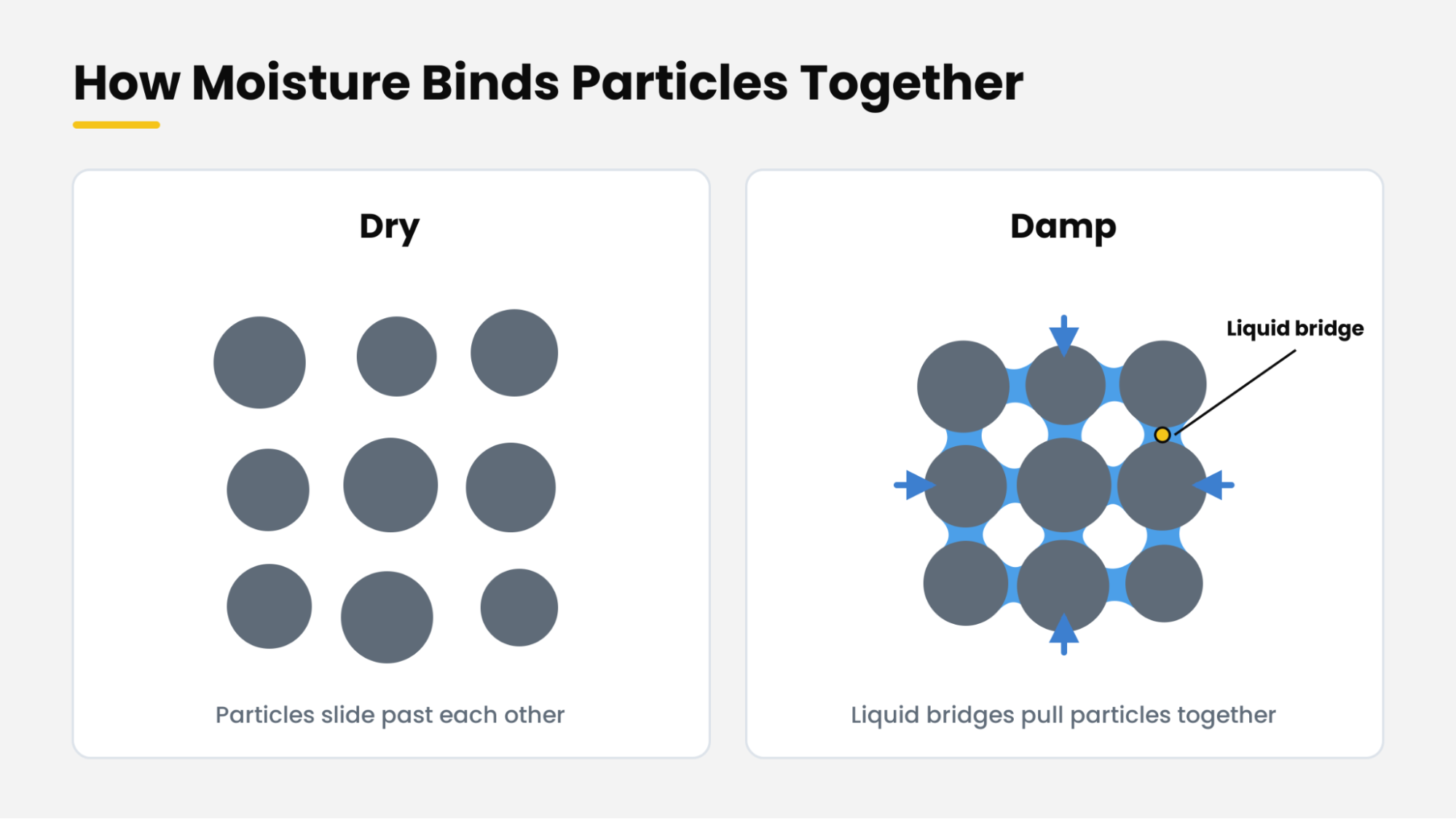
Dry, free-flowing particles move past each other with little resistance. Add water, and thin films form on particle surfaces. Where two wet particles touch, the water forms a tiny liquid bridge between them. Surface tension in that bridge pulls the particles together, much like wet sand holds the shape of a sandcastle while dry sand does not.
Those bridges increase cohesion (how strongly particles stick to each other) and adhesion (how strongly they stick to hopper walls, chutes, and screens). The result is a material that resists sliding, holds a steeper slope, and needs more force to start moving.
How Material Flow Changes as Moisture Increases
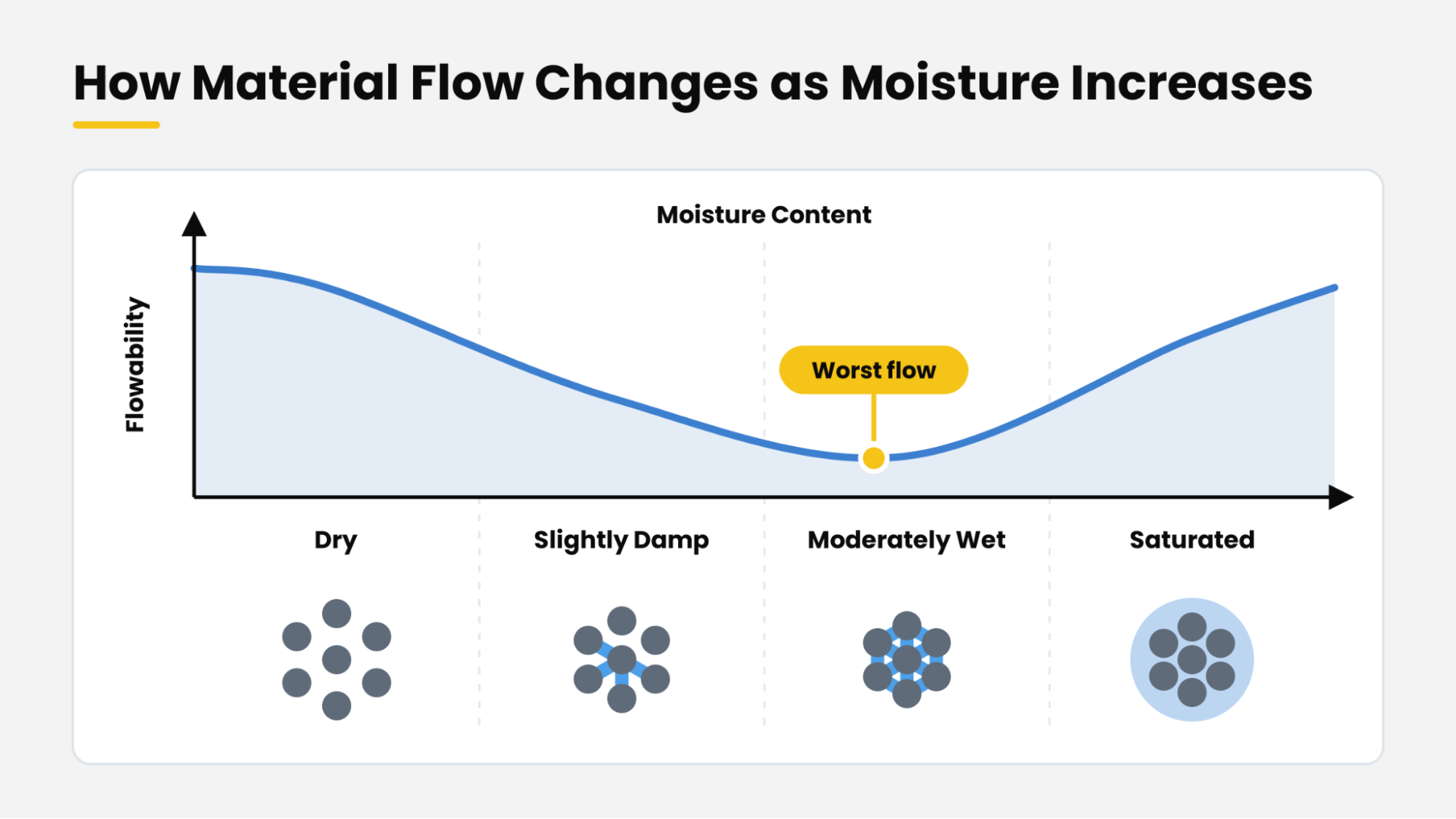
One of the most misunderstood points about moisture is that flowability does not simply decline as water increases. For many materials, the pattern looks like this:
- Dry: Particles flow freely, though very fine dry powders can still be cohesive or dusty.
- Slightly damp: Isolated liquid bridges form. Cohesion rises quickly, and problems often start here.
- Moderately wet: Bridges connect throughout the material. This is often the stickiest, worst-flowing range.
- Very wet or saturated: Spaces between particles fill with water, bridges lose their pull, and the material starts behaving more like a slurry.
The moisture level where flow is worst is different for every material. Particle size, shape, and surface chemistry all shift it. Fine particles are especially sensitive because they have far more contact points per pound than coarse ones.
Other Changes That Come With Moisture
Moisture also changes several properties that bin and feeder designs depend on:
- Bulk density often drops at first as damp particles cluster into loose, open structures, then rises as the material packs under its own weight.
- Angle of repose typically increases, so piles stand steeper and material is less willing to slide down hopper walls.
- Wall friction usually rises, which can change a hopper from mass flow to funnel flow.
- Consolidation over time becomes more pronounced, so material left sitting in a bin gains strength the longer it stays.
Common Flow Problems Caused by Moisture
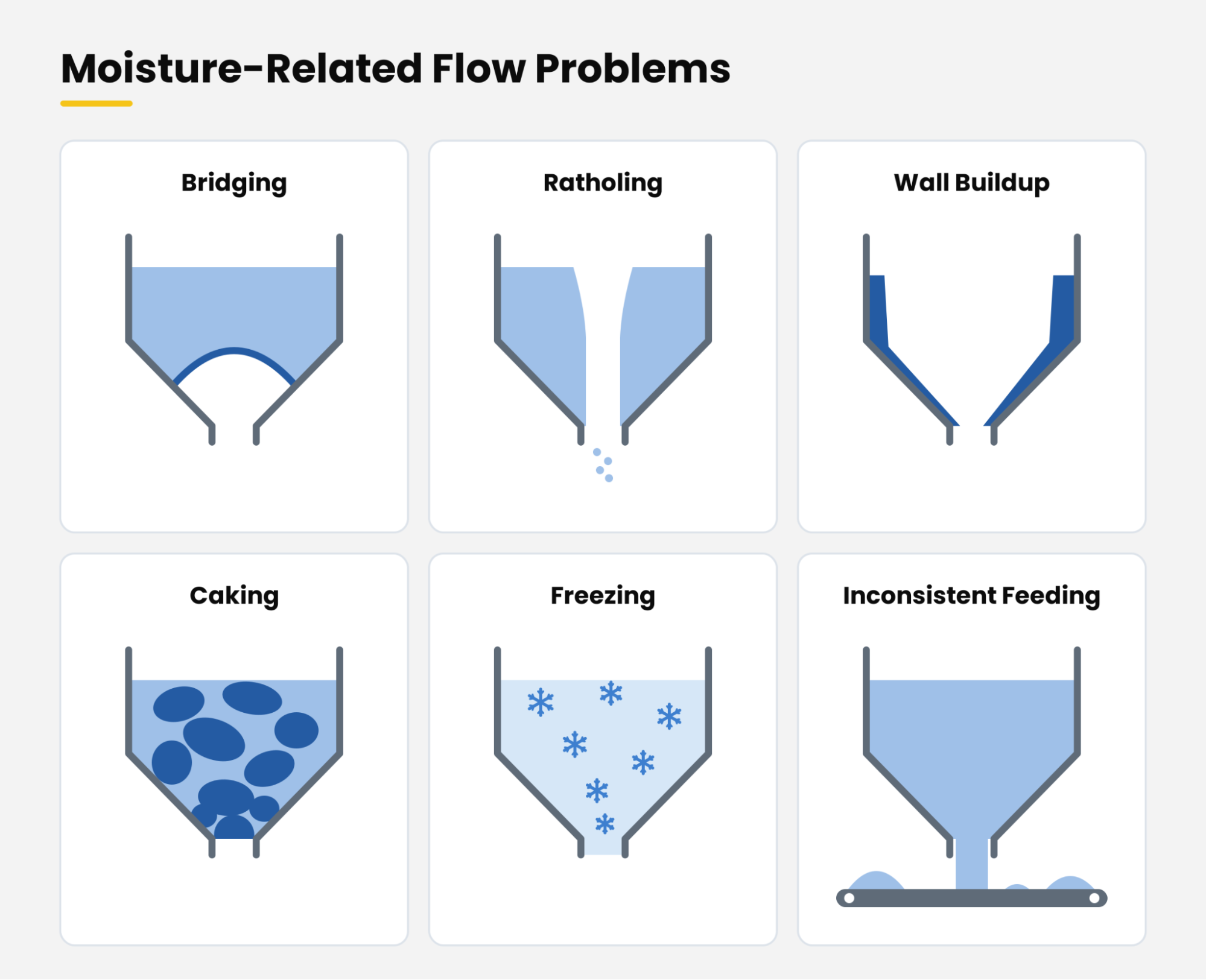
When cohesion and wall friction rise, the same handful of flow problems tend to show up. Recognizing which one you have is the first step toward fixing it.
Bridging (Arching)
Damp material forms a stable arch across the hopper outlet, and flow stops completely. Because moisture increases particle-to-particle strength, a wetter material can bridge across a larger opening than the same material in a dry state.
Ratholing
Material flows only through a narrow channel above the outlet while the rest stays stuck against the walls. Once the channel empties, flow stops, and the stagnant material left behind keeps absorbing moisture and gaining strength.
Wall Buildup
Sticky material adheres to hopper walls, chutes, and transitions. Layers grow over time, shrinking the effective outlet size and eventually breaking loose in large chunks that can jam downstream equipment.
Caking
Caking happens when particles bond into hard lumps or a solid layer. In hygroscopic materials, a common cause is moisture cycling: particles absorb water when humidity is high, dissolve slightly at their surfaces, then recrystallize into solid bridges when conditions dry out. Temperature swings in silos and railcars can also drive moisture to colder surfaces, where it condenses and causes localized caking.
Freezing
In cold weather, moisture in materials such as aggregates, coal, ores, and grain can freeze, locking particles together. Frozen material in railcars, trucks, and outdoor bins is one of the most stubborn unloading problems.
Inconsistent Feeding
Even when material does not stop entirely, changing moisture content leads to erratic flow rates. That affects feeder accuracy, batching, filling, and packaging, often showing up as weight variation or off-spec product rather than an obvious blockage.
How to Measure and Anticipate Moisture Effects
You cannot manage what you do not measure. A few practical steps make moisture-related flow problems far more predictable:
- Measure moisture regularly. Loss-on-drying (weighing a sample before and after heating) is the most common method. Inline sensors using near-infrared or microwave technology can track moisture continuously on conveyors and in bins.
- Track ambient conditions. Logging temperature and relative humidity in storage areas helps link flow problems to weather and seasonal patterns, especially for hygroscopic materials.
- Test flow properties at several moisture levels. Shear cell testing measures how much strength a material develops under pressure and how it slides against wall materials. Testing flowability at different moisture contents shows where your material’s worst-flowing range sits.
- Account for time in storage. A material that flows well right after filling may not after sitting over a weekend. Time-consolidation testing reveals how much strength builds while material is at rest.
- Keep a problem log. Recording when hang-ups occur, along with moisture readings and conditions, often reveals a clear threshold above which trouble begins.
Process Controls That Reduce Moisture-Related Flow Problems
The most reliable solutions usually combine prevention with a dependable way to restore flow when conditions change. Common process controls include:
- Keep moisture out. Seal bins and silos, cover outdoor storage, use desiccant breathers on vents, and keep doors and hatches closed in humid areas.
- Control the storage environment. Dehumidification and temperature control limit moisture pickup and the condensation that drives caking.
- Dry the material. Dryers or conditioning steps can bring incoming material below its problem threshold, especially for resins and food ingredients.
- Use flow additives where permitted. Anti-caking agents coat particles and reduce bridging between them. Whether they are appropriate depends on the product and its regulations.
- Reduce storage time. First-in, first-out inventory and smaller, more frequent fills limit how long material sits and gains strength.
- Design for wetter conditions. Steeper hopper walls, smoother wall liners, and larger outlets help material keep moving when moisture rises.
Even with good controls, moisture content still varies with weather, supplier, and season. That is where mechanical flow aids come in.
Using Industrial Vibration to Keep Moist Materials Flowing
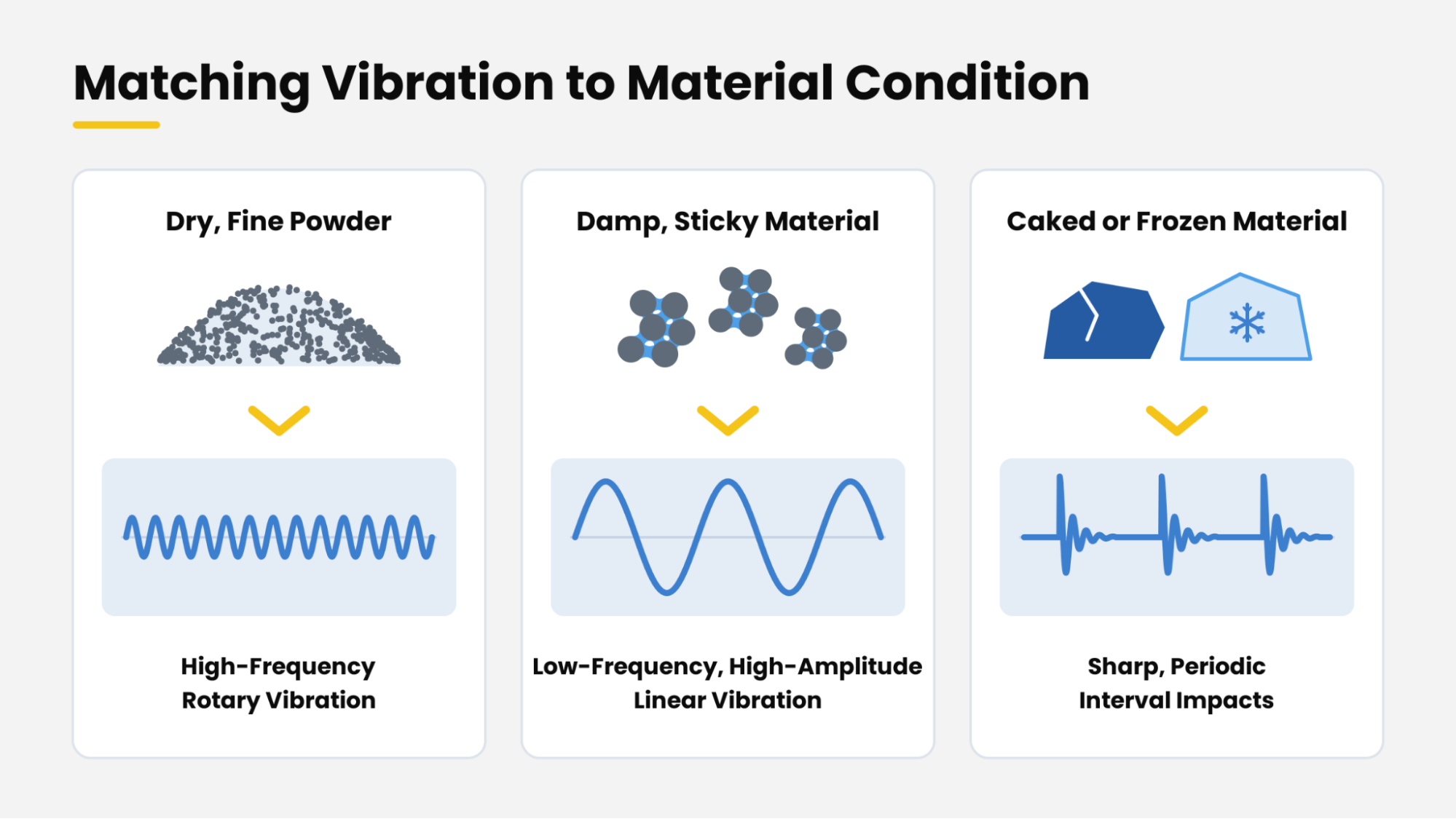
Hopper vibrators, bin vibrators, and vibrators mounted on chutes and trailers apply energy that breaks the liquid bridges and wall adhesion holding damp material in place, restoring flowability. The key is matching the type of vibration to how the material behaves at its current moisture level.
Low Frequency, High Amplitude for Sticky and Damp Materials
Wet, cohesive materials tend to absorb fast, light vibration without moving. They usually respond better to slower, stronger strokes that physically dislodge material from the wall. Pneumatic linear (piston) vibrators deliver this kind of motion and are a common choice for damp, sticky materials, wall buildup, bridging over outlets, and ratholing.
Impact for Caking, Buildup, and Frozen Material
When material has caked or frozen into a solid mass, a sharp, periodic blow is often more effective than continuous vibration. Interval impactors strike the wall at set intervals, similar to a hammer but without denting the hopper. They are well suited to heavy buildup, caked hygroscopic materials, and cold-weather unloading of railcars and trucks.
Higher Frequency for Fine, Drier Powders
Rotary vibrators, whether pneumatic or electric, produce higher-frequency vibration that keeps fine particles fluidized and moving. They work well for drier powders and for materials that are only mildly affected by humidity, but are generally less effective on very sticky, wet materials.
Unloading Trucks and Trailers
Portable vibrators that clamp onto hopper trailers and railcars help discharge damp or frozen loads without pounding on the hopper, which damages equipment and creates safety risks.
Best Practices When Vibrating Moist Materials
- Run vibrators only when material is discharging. Vibrating a full bin with the outlet closed can pack damp material tighter and make the problem worse.
- Place vibrators where problems form. Mounting a hopper or bin vibrator on the sloped section near where arching, ratholing, or buildup occurs puts energy where it is needed most.
- Use timers and controls. Intermittent operation, or impactors on adjustable intervals, deliver energy only when needed and reduce wear.
- Plan for seasonal change. A solution sized for summer humidity or winter freezing will handle the rest of the year more easily.
Because moisture affects every material differently, the right vibrator depends on your material, its moisture range, vessel size and wall thickness, available power, and duty cycle. Our Application Engineers can help you evaluate these factors and identify the right solution for your application.
Keep Moisture From Stopping Your Process
Moisture changes how bulk materials behave in ways that are not always obvious, from the first damp film that raises cohesion to the caking and freezing that bring unloading to a halt. Measuring moisture, controlling storage conditions, and choosing the right flow aids for your material’s real-world range will keep your process predictable year-round.
If moisture is causing bridging, ratholing, buildup, caking, or unloading problems in your operation, Martin Vibration Systems & Solutions can help.
Call or send a message to our Application Engineers to identify the right solution for your material and application.