 En Español

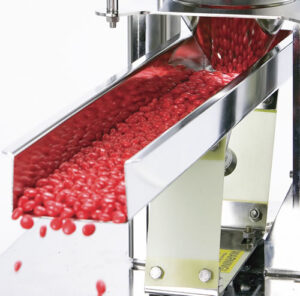 Industrial Vibration for Feeding Applications
Transferring product — from powders to loose parts — into containers for shipping or retail packaging is slow and labor-intensive when it relies on hand-scooping bulk solids. The repetitive motion is inefficient, and accuracy suffers whenever containers need to be filled to a specific weight or volume, which is common even in small food packaging operations.
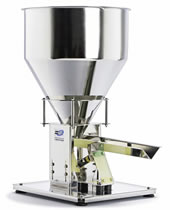
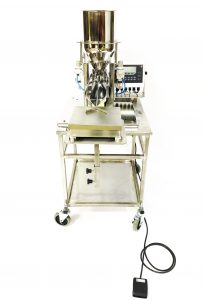
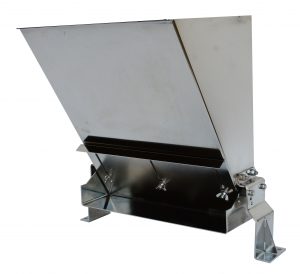
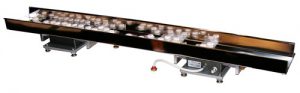
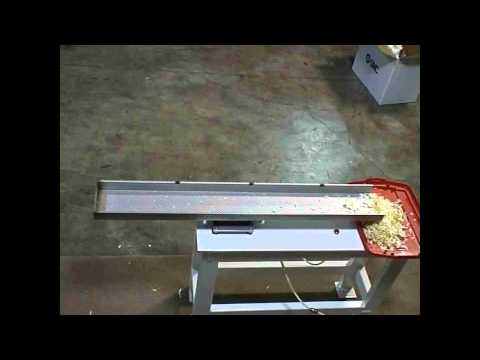
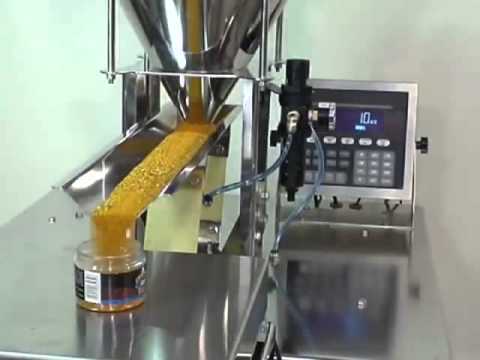
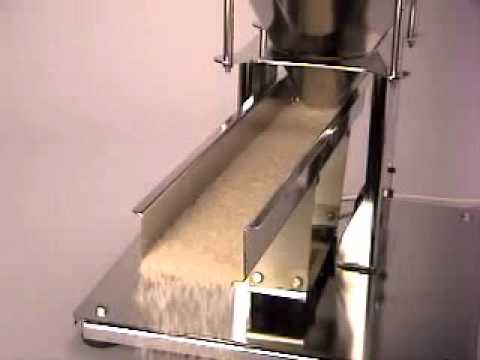
A hopper or feeder assembly that uses vibration to move product solves this by making the filling process semi-automatic, cutting down on manual handling. Because vibration moves material gently rather than mechanically pushing or scooping it, the risk of product damage is minimal. Amplitude and frequency are both adjustable, so throughput stays highly accurate, and pairing a vibratory feeder with an electronic scale makes feeding product into containers by weight a fast, repeatable process.
How Vibratory Feeding Works
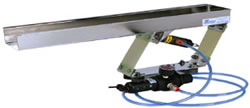
A vibratory feeder moves material along a tray or trough using controlled, directional vibration instead of belts, screws, or manual pushing. Adjusting the amplitude and frequency changes the feed rate, so the same unit can handle a light dusting of seasoning or a steady stream of several tons per hour. Because the motion is gentle and precisely tunable, feeders can move everything from delicate food products to abrasive industrial materials without damaging the product or excessive wear on the equipment.
Industries That Rely on Vibratory Feeding
- Food and bakery production
- Chemical processing
- Pharmaceuticals and nutraceuticals
- Retail and consumer packaging
- Any operation currently relying on hand-scooping or manual container filling