 En Español

Industrial Vibration for Compacting Applications

When you’re shipping or storing bulk solids, volume is money. The more product you fit in a container, the lower your cost per unit shipped and stored. If loose material — ping-pong balls, lugnuts, ketchup packets, granular powders — settles during transport, you end up paying to ship empty space, and it happens on every truck ride because road vibration naturally compacts loose material over distance.
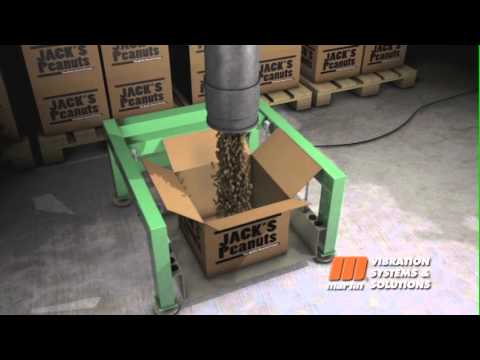
A vibratory compaction table solves this proactively. Mounting an industrial vibrator to the table while a container is being filled settles the material before it ships and flattens the angle of repose, the cone-shaped mound that builds up as you fill a container. That’s critical if the container needs a lid or a sealed top. Compaction tables handle a wide range of materials, including those with high moisture content, and are equally effective on loose parts, bulk powders, and thick liquids like melted chocolate that need de-aeration before cooling. In food production, pre-settling frozen fruit and vegetables during packing also reduces the freezer volume you need to operate and maintain leading to direct cost savings.
How Vibratory Compacting Works

Vibration moves material at the particle level. As a compaction table vibrates, the applied energy reduces particle-to-particle friction as well as friction between the material and the container walls. This allows particles to shift more freely into gaps and voids left during filling, creating a denser, more evenly distributed load with a flatter surface.
For irregularly shaped parts with a high tendency to interlock or become entangled, vibration also helps reduce mechanical binding and friction between individual pieces, allowing them to settle into a more compact arrangement.
The process achieves greater packing density without applying enough force to damage the product itself. Amplitude and frequency are both adjustable, so the same principle scales from delicate food items to heavy industrial components.
Industries That Rely on Vibratory Compaction
- Food and beverage packaging
- Pharmaceuticals and nutraceuticals
- Chemical processing
- Construction and building materials
- Any operation shipping loose parts or granular product in bulk