
 En Español

The right industrial vibrator depends on three things: the material you are moving, the equipment holding it, and the result you need. Pick the wrong type and you can make a flow problem worse, packing powder tighter, cracking a hopper wall, or burning out a unit that was never built for continuous duty.
This guide walks through every type of industrial vibrator Martin Vibration Systems & Solutions carries, how each one works, and when to use one over another. Use it to narrow your options. Then let our application engineers do what they do best: match the exact model, size, force, and mounting to your unique specifications and application, at no charge.
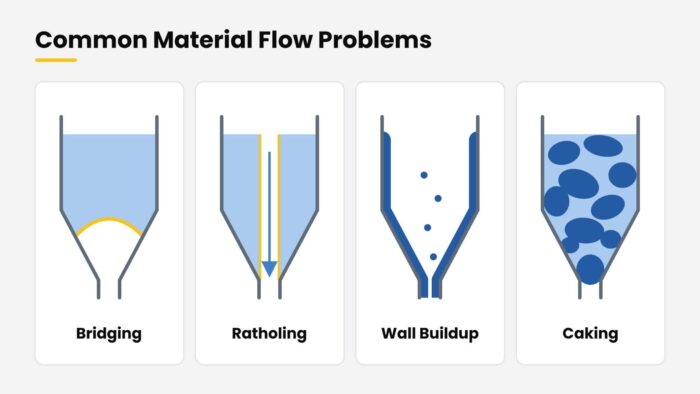
Common Material Flow Problems
Before choosing a vibrator, it helps to name the problem. Most bulk material flow issues fall into one of four patterns, and each responds differently to vibration.
Bridging
Material forms an arch over the outlet and flow stops completely. It is common with cohesive powders and particles that interlock. The right vibration breaks the arch so material can fall freely.
Ratholing
Material flows only through a narrow channel above the outlet while the rest stays stuck against the walls. The bin appears to empty, but stagnant product remains, which can lead to spoilage or mixing between batches. Vibration on the vessel walls activates the stagnant material.
Wall Buildup
Sticky or moist material clings to vessel, chute, or pipe surfaces, gradually narrowing the passage and contaminating later batches. Impacting vibrators and interval impactors are often used to shed it.
Caking
Material settles and packs under its own weight, especially after sitting in storage or riding in a trailer or railcar. Vibration loosens it, but the wrong type of vibration can pack it even tighter.
Many vessels show more than one of these at once. Describing what you see, and when it happens, is one of the most useful things you can share with an application engineer.
The Four Choices That Drive Industrial Vibrator Selection
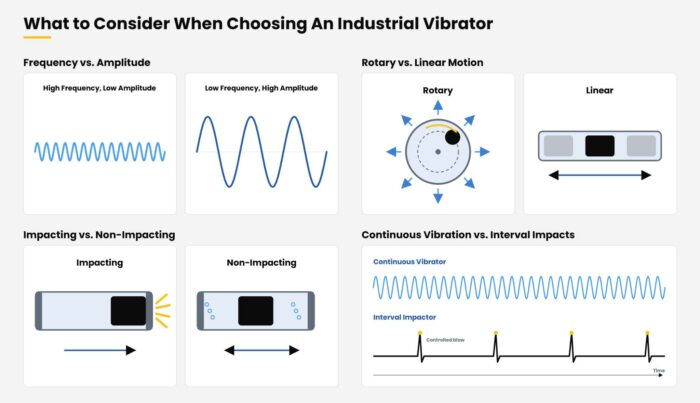
Every vibrator in our line is defined by a few core characteristics. Understanding them makes the product categories that follow much easier to navigate.
Frequency vs. Amplitude
High-frequency, low-amplitude vibration suits fine, dry powders. It reduces friction between particles and the vessel wall so material slides out. Low-frequency, high-amplitude vibration suits larger particles, light or fluffy materials, and lumpy or sticky product that needs a bigger “shove” to break loose.
Rotary vs. Linear Motion
Rotary vibrators spin an eccentric mass (a ball, roller, turbine, or weighted motor shaft), producing force in a circular pattern. Linear vibrators drive a piston back and forth along one axis, directing energy straight into the vessel wall or the equipment being moved.
Impacting vs. Non-Impacting
An impacting vibrator strikes the mounting surface, creating high acceleration to knock sticky material free. A non-impacting vibrator moves the structure without striking it, which is quieter and gentler on vessels and fragile product.
Continuous vs. Interval
Some applications need vibration running the entire time material flows. Others need a single, controlled blow at set intervals to break a bridge or shed buildup.
What drives these choices is the material itself. Particle size, bulk density, moisture content, and how cohesive or sticky a material is all determine which frequency, amplitude, and force will work. A free-flowing granule and a damp, clumping powder in the same hopper may need entirely different solutions.
Most real-world problems involve trade-offs between these variables. The sections below explain how each vibrator type handles them.
Choosing Between Pneumatic vs. Electric Vibrators
The first fork in the road is how the vibrator is powered.
Pneumatic vibrators run on compressed air. Intensity is adjustable through air pressure, there are no electrical components to spark, and they hold up in high-heat, corrosive, and wash-down environments. Their light weight and simple installation make them easy to reposition. They are a natural fit when plant air is already available, when you need to start and stop on demand, or when hazardous-area safety is a priority.
Electric vibrators are rotary motors with adjustable eccentric weights, built for continuous duty. Available in single-phase and three-phase models, they deliver steady, energy-efficient force for hours on end without the air consumption or exhaust noise of pneumatic units. They are the go-to choice when compressed air is limited or costly, when a vibrator will run all shift long, or when you need to quiet a clanging piston vibrator.
Neither is universally better. Air availability, duty cycle, noise limits, and area classification all factor into the decision.
Types of Industrial Vibrators
Pneumatic Rotary Vibrators
Pneumatic rotary vibrators use compressed air to spin a mass (a ball, a turbine wheel, or a roller) around a race or housing. The result is high-frequency vibration that reduces friction between particles and the vessel wall. They are the classic flow aid for fine, dry material in bins, hoppers, chutes, screens, and feeders.
Ball Vibrators
A ball vibrator drives a hardened steel ball around a circular race. The ball is the only moving part, which keeps the design simple, compact, and inexpensive.
Use a ball vibrator when: you have small hoppers, parts feeders, chutes, or match plates; the material is fine and dry; vibration is needed intermittently rather than all shift; and you want a low-cost solution.
Consider another type when: the unit must run for long periods, air consumption is a concern, or the material is heavy or dense.
Turbine Vibrators
A turbine vibrator uses air to spin an unbalanced turbine wheel on bearings. It produces smooth rotary force with far less air and noise than a ball vibrator.
Use a turbine vibrator when: you need continuous high-frequency vibration on fine, dry material and want to reduce compressed air costs and noise. Turbines are common in parts handling, electronics manufacturing, and bottling.
Consider another type when: material is coarse, sticky, or lumpy and needs more amplitude than high-frequency vibration provides.
Roller Vibrators
A roller vibrator circulates a steel roller instead of a ball. The larger contact mass generates higher centrifugal force for its size, making roller units the heavy hitters of the pneumatic rotary family.
Use a roller vibrator when: a ball or turbine vibrator lacks the force for your material density or vessel size; you are evacuating high bulk-density material; you need to keep material from adhering to pipes, plates, or chutes; or the unit will operate in wet, dirty conditions.
Consider another type when: the vessel is small or thin-walled, or the material is light and fluffy and needs low-frequency movement instead.
Learn more:
Pneumatic Linear (Piston) Vibrators
Pneumatic linear vibrators drive a piston back and forth, concentrating force along a single axis. That focused energy is ideal for moving, settling, and separating material, and for driving equipment such as feeders, screens, and compaction tables.
The most important decision within this family is impacting versus non-impacting: whether the piston strikes the mounting surface. Choose wrong, and you can pack material tighter or stress a vessel wall. If you are not sure which your material responds to, our application engineers can help you test and decide.
Non-Impacting Piston Vibrators
In a non-impacting design, the piston reverses direction without striking the housing. The vessel moves, but nothing hammers against it.
Use a non-impacting vibrator when: noise limits are tight; vessel walls are thin or delicate; the material is light, coarse, or prone to compacting; or you need gentle, even movement for dosing and feeding. Low-frequency, high-amplitude models work especially well for larger particles and light bulk densities.
Consider another type when: material clings or cakes on vessel walls and needs a sharper jolt to break free.
Impacting Piston Vibrators
An impacting vibrator lets the piston strike the housing on every stroke, sending a sharp shock into the vessel wall. That high acceleration knocks loose material that gentler vibration slides right past.
Use an impacting vibrator when: sticky or cohesive material builds up on walls, and non-impacting vibration is not enough to release it.
Consider another type when: the material packs under shock, the vessel is fragile, or noise is a concern.
Pneumatic Oscillators
An oscillator is a precision linear vibrator built for controlled, repeatable motion. Amplitude and frequency can be adjusted independently, and the unit starts and stops instantly in any position.
Use an oscillator when: you are driving a compaction table, feeder, or screen; settling and densifying powders; separating or spreading product on a conveyor; or you need quiet, lubrication-free operation in sanitary or explosive environments.
Consider another type when: the main goal is simply breaking up a bridge in a large bin, where a heavier vibrator or impactor may be more effective.
Miniature Air Vibrators
Miniature vibrators shrink the piston design into a compact body for small vessels and tight spaces.
Use a miniature vibrator when: the hopper is small, mounting space is limited, and the process involves food or pharmaceutical production.
Consider another type when: the vessel is large or the material is heavy.
Martin Vibration Systems & Solutions carries this type as the MARTIN® Bantam Series of Miniature Air Vibrators.
Compacting Vibrators
Compacting vibrators, used in compaction or settling tables, are piston units designed specifically to settle material in bags, boxes, and containers during filling.
Use a compacting vibrator when: you want to increase fill weight, reduce container size, or flatten the mound that forms as product is filled.
Consider another type when: the goal is moving material out of a vessel rather than settling it in.
Learn more:
- Non-impacting piston vibrators
- Impacting piston vibrators
- Pneumatic oscillators
- Miniature air vibrators
- Compacting vibrators
Interval Impactors
An interval impactor is a different tool from a vibrator. Instead of continuous motion, a pneumatic piston delivers individual, controlled blows, like a hammer strike, without dented walls or worker injury risk. Blows can be triggered on demand, by a timer, or by a sensor. For example, an impactor can fire a few strokes during each emptying cycle, then a short burst every few minutes to keep bridges from forming between batches.
Use an interval impactor when:
- Material does not respond to rotary vibration
- Continuous vibration would compact the material further
- Bridged material needs to be broken up
- Dusty residue builds up in spray dryers, pipes, ducts, or dust collectors
- Operators are currently banging on bins with mallets
Consider another type when: material needs constant agitation to keep flowing, or you are feeding or dosing at a steady rate.
Impactors are sized to vessel wall thickness. Too large a unit can damage the wall; too small will not clear the problem. Our application engineers will match the model and firing interval to your vessel.
Learn more:
Electric Rotary Vibrators
An electric vibrator is a motor with eccentric weights on each end of its shaft. Adjusting the weights changes force output, and the motor runs continuously without compressed air. Electric vibrators come in several distinct types, each suited to different duty levels and environments.
Compact Electric Vibrators
Small-frame motors that bring continuous-duty electric vibration to confined spaces.
Use one when: you are powering small feeders, screens, or separating and light compacting equipment where space is tight.
Consider another type when: the vessel or load is large.
Standard-Duty Electric Vibrators
General-purpose industrial motors built for everyday continuous operation on bins, hoppers, chutes, and screens.
Use one when: you need reliable, all-shift vibration and compressed air is limited or costly.
Consider another type when: the environment is extreme, the load is very heavy, or the area is classified as hazardous.
Heavy-Duty Electric Vibrators
Reinforced motors designed for the harshest industrial environments and largest structures.
Use one when: conditions are punishing, vessels are large, or you want to replace noisy air-driven piston vibrators with quieter electric power.
Consider another type when: the application is small or intermittent, where a lighter unit is more economical.
High-Amplitude Electric Vibrators
Motors tuned for low-frequency, high-amplitude motion: the electric counterpart to a low-frequency piston vibrator.
Use one when: you need to dislodge lumpy, sticky, or light, fluffy material that high-frequency vibration will not move.
Consider another type when: the material is a fine, dry powder that responds better to high frequency.
Explosion-Proof Electric Vibrators
Motors built for hazardous locations where explosive gases or combustible dusts are present.
Use one when: you need continuous electric vibration in feed mills, chemical plants, munitions facilities, or any classified area.
Consider another type when: the area is not classified, since standard or heavy-duty units will cost less.
DC Vibrators for Trucks and Trailers
Direct current vibrators run on a vehicle’s electrical system, bringing vibration to equipment with no plant power or air supply.
Use one when: topsoil, cement, gravel, or other material sticks in dump truck beds and trailers, and drivers are sweeping or shoveling it out by hand.
Because electric vibrators must be matched to the structure’s weight and stiffness, our application engineers will calculate the right model and weight setting so your equipment is neither under- nor over-driven.
Learn more:
- Compact electric vibrators
- Standard-duty electric vibrators
- Heavy-duty electric vibrators
- High-amplitude electric vibrators
- Explosion-proof electric vibrators
Portable and Transport Vibrators
Not every application calls for a permanently mounted unit. Some vibrators are designed to move between vessels or ride along on trucks and railcars.
Portable Vibrators
Portable vibrators attach and detach quickly, usually with a vacuum base or a quick-change mount, so one unit can serve many vessels.
Use one when: you have many bins, boxes, or totes that each need occasional help, or you want to test vibration on a problem area before committing to a permanent installation.
Consider another type when: one vessel needs vibration every cycle, where a permanently mounted unit is more practical.
Trailer Vibrators
Trailer vibrators mount on hopper or dry bulk trailers and run on the truck’s own air supply.
Use one when: grain, DDG, cement, flour, or other material hangs up during unloading, and drivers are waiting on slow discharge or climbing on trailers to hammer it loose.
Railcar Vibrators
Railcar vibrators attach to covered hopper cars at the unloading station to free material that compacts during transit.
Use one when: cars are not emptying completely, and crews are relying on manual methods that add labor and safety risk.
Learn more:
Other Factors That Affect Vibrator Selection
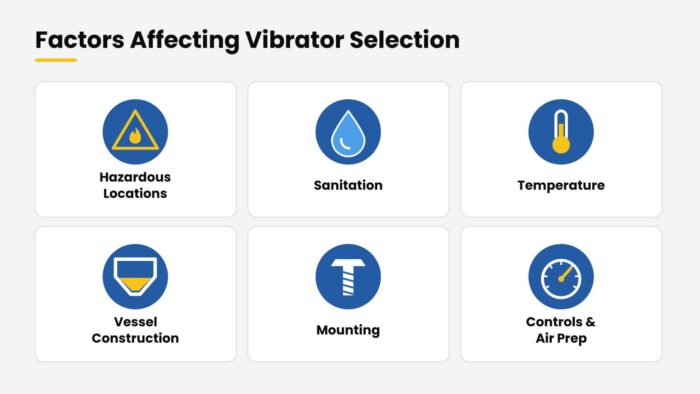
Vibrator type is only part of the specification. Our application engineers also evaluate:
- Hazardous locations: Feed mills, chemical plants, and munitions facilities often require ATEX-certified pneumatic units or explosion-proof electric vibrators.
- Sanitation: Food, pharmaceutical, and cannabis lines may call for sanitary coatings, lubrication-free designs, wash-down construction, or stainless steel.
- Temperature: Foundries, dryers, and kilns need units rated for high-temperature service.
- Vessel construction: Wall thickness, material, and stiffeners determine how much force a vessel can safely take and where the unit should mount.
- Mounting: Options range from weld-on mount kits to our proprietary Adhesive Mounting System, which requires no welding, drilling, or bolting.
- Controls and air preparation: Timers, sequence controls, and air preparation packs can extend unit life and fine-tune performance.
Any one of these factors can rule out an otherwise ideal vibrator type, which is why it pays to consult with our team on the full picture before ordering.
Let Our Application Engineers Determine Your Best Option
With more than 100 models of industrial vibrators in stock, there is almost always more than one way to solve a material flow problem, but only one best way for your operation. The fastest route to it is a conversation with someone who has solved thousands of problems just like yours.
Tell us about your material, equipment, temperature, sanitation requirements, and hazardous-area classification. Our application engineers will recommend the best vibrator, or combination of vibrators, for your unique needs, specifications, and application. Engineering assistance is free, and we back our recommendations with a money-back guarantee.