Posts Tagged ‘industrial vibrator’

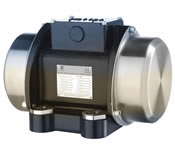
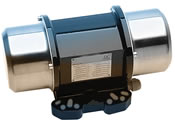
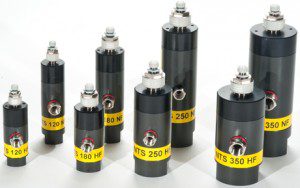
NTS 50/04 Linear Vibrator – Consolidation

Tuesday, January 25th, 2011

Problem:

An Arkansas gypsum plant manager became concerned about air consumption. They saw that they would need to reduce the load on the plant air system or be forced to upgrade to a larger compressor.

Situation:

The plant, for many years had used a VIBROLLER® UCVR 6-.5 Vibrator installed underneath the mixer belt to vibrate and form the gypsum slurry. This roller vibrator did a good job of consolidating the material, and so periodically as needed, the plant would just replace a worn-out vibrator with a new one.

Solution:

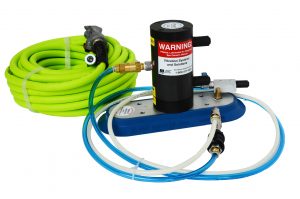
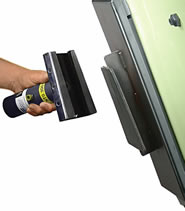
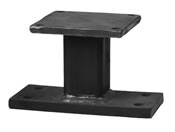
To demonstrate, the NTS 50/04 Linear Vibrator was placed on a VAC-MOUNT™ Portable Mount. At 60 psi, the NTS 50/04 Vibrator is rated at 10 cfm–less than half of the VIBROLLER® Vibrator’s 21 cfm air consumption.

With the VAC-MOUNT™ Portable Vibrator applied temporarily underneath the mixer belt, the plant could see its effective vibration. As a result, they bought an NTS 50/04 and permanently installed it to replace the roller vibrator.

The NTS 50/40 did better job of consolidation, with quieter operations. And most importantly, they are using less air, reducing energy consumption, and avoiding the purchase of a larger air compressor.

Electric Bin Vibrators – Important for Good Flow

Sunday, January 16th, 2011

It is common for material flow problems to occur in bins, hoppers, and silos. Many of these problems are caused by a high level of friction between the material and the bin wall, and high cohesive strength within the material. When examining wall friction take into account the wall angle, wall material, smoothness, temperature, moisture, corrosion, abrasive wear, and the time the material remains at rest in the cone where the problem exists. Also the cohesiveness is affected by material properties, including moisture content.

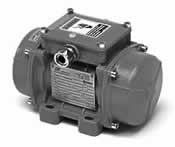
When material flow problems occur solving these problems is essential for efficient production and accurate material inventory management. The key to solving these problems is to employ an industrial electric vibrator. Electric bin vibrators are used to break the friction between wall and material, as well as material cohesiveness, to promote material flow from the bin.

Industrial vibrators when properly selected offer an effective and high value solution. Martin Vibration Systems can provide with that solution. We offer many designs in vibration technology to fit your unique situation.

CD18-70 Electric Vibrators

Sunday, January 16th, 2011

Problem:

A large manufacturer of metal shelving was experiencing a parts flow problem on a sheet metal press. The parts being stamped were plugging the die which caused frequent quality problems and “die” damage.

Situation:

A temporary solution was to have a worker stand on the other side of the press and manually pull hung-up parts with a hook, a tedious, costly, and potentially dangerous solution.

Solution:

Martin Vibration designed a vibrating chute using two CD18-70 electric vibrators. Parts now flow without trouble.

Since using our vibrators, the manufacturer has been able to increase production and move their worker to a much more needed and productive role.

Case Study: Aluminum Shot – NTK-85 Solution

Friday, November 12th, 2010

Problem:

A manufacturer of aluminum shot was having serious quality control problems regarding the size and shape of his product. Pieces were deformed or elongated to the point where his customers were complaining.

Situation:

The current solution was to use MARTIN® UCVR-8.20 Vibrators to meter the product during its formation. This method gave them the required tonnage per hour but not the surface quality they desired.

Solution:

The introduction of an NTK®-85 Oscillating Vibrator has since greatly improved the uniformity of their product while maintaining desired production levels. The additional benefits of less noise and reduced air consumption have greatly improved the work environment.

Case Study: Chute Build Up – NTS 54/02 Vibrator

Thursday, October 21st, 2010

Problem:

An automobile assembly plant in Detroit Michigan was experiencing build up on the chute walls in their fuel handling system.

Situation:

This assembly plant has their own coal-fired utility. Some of the chutes in their fuel-handling system plug up from buildup on the chute walls over a period of time. To prevent this from happening operators constantly use air lances and shovels to clean the buildup daily. This took a lot of the operators’ time away from further improvements or maintenance areas in the plant.

Solution:

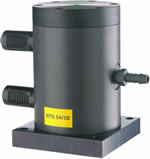
We introduced the NTS 54/02 on a VAC 20 MOUNT, a portable unit that takes care of the buildup and gives the operators more time to work in other areas.

Case Study: Broken Glass Buildup – NTS Vibrator with VAC MOUNT

Thursday, October 14th, 2010

Problem:

A large plate glass manufacturer in Toronto was dealing with two problems: broken glass in a scrap reclaim bin not vacating, and compensation claims for back injuries resulting from the periodic cleaning of this bin.

Situation:

Except for scheduled maintenance or breakdown, the line is never shut down. Thus, when the glass is not being cut and stacked, the material is “thrashed” and recycled. It was at this station the problem existed. The bin, approximately 8’ wide by 30’ long, had less than a 2-1/2′ drop (roughly 5°). The operators were using long poles to push the glass shards to the discharge, which periodically resulted in a back injury claim.

Solution:

Demonstration was key in showing the customer the solution to their problem. Even though there was noise from the thrasher, the customer may now vibrate and clean this bin during cutting and stacking without excessive noise from piston type vibrators.

5 Reasons Why Vibrating Tables Increase Your Bottom Line

Thursday, September 30th, 2010

Vibrating tables are often critical components of production and industrial flow systems. Hoppers, bins, feeders, and packaging systems can all benefit from vibration.

1. Improve product flow and consistency. Vibration breaks the friction between materials and allows them to flow freely. This benefit will save money by reducing product loss caused by build up in hopper, clogging or jams in line, overspill and other material flow problems.

2. Safer Work Environment. Martin Vibrators are less noisy as traditional industrial vibrators. Most operate below OSHA noise standards therefore reducing hearing damage. Since vibrators eliminate clogs in bins and hoppers, employees are not at risk clearing these clogs.

3. Improves Packaging. Vibration compacts bagged material, therefore more tight fitting bagged material for shipping.

4. Improves production time and lowers labor costs. No more wasted labor hours. Time spent cleaning and unclogging will now be used toward more productive, value added tasks.

5. Eliminate waste. Martin vibrations systems helps to eliminate waste in most material flow systems by reducing clogs and waste by improving accuracy, consistency and quality of your material flow systems.

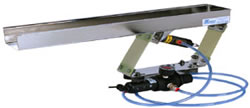
What is a Vibratory Feeder?

Saturday, September 25th, 2010

Getting bulk material to flow readily can be a challenge. A vibratory-feeder is a versatile machine that vibrates and enables loose materials to be conveyed or transferred along a trough, screen or tube. This initiates the movement of bulk materials such as fine powders, grains, aggregates or cement in a forward motion along the trough, similar to a conveyor belt.

A Vibratory feeder is an ideal ‘compact’ solution for increasing bulk handling productivity that integrates easily into an operation or production line. It offers an economical means of product flow for conveying loose materials from volumetric-bins, hoppers and chutes. A vibratory feeder is suitable for just about any industry, application or environment for bulk materials in mixing, blending, batching or packaging operations, for either continuous or intermittent flow.

Need Help with a Flow Problem?

Tuesday, September 14th, 2010

Getting bulk material to flow readily can be a costly challenge. In some applications, bulk powder, granular material and liquids are combined to create a thick slurry. Getting this thick slurry to flow consistently depends on the angle of your discharge and the thickness of your mixture.

One example of potential flow problem is with concrete. Most problems with concrete occur when the concrete is discharged from the mix trucks. Two common problems with concrete flow is the strength of the mixture and the friction between the mixture and the material it flows thru.

To ensure a smooth flow, an industrial vibrator is used. Industrial vibrators produce several pounds of force into the material to promote and maintain a constant concrete flow. An efficient and effective vibrator is the MARTIN® WHIRLWIND™ High-Frequency Turbine Vibrator. It produces more power with less noise than any other high-force/high-frequency pneumatic turbine vibrator. Units mount easily to cradle lug brackets or rail car wedge brackets, and operate quietly to meet OSHA noise requirements.

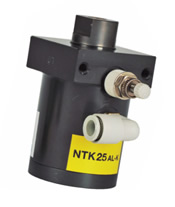
Case Study: Providing A Solution – NTK-25 Vibrator

Tuesday, September 14th, 2010

Problem:

A large bakery in Atlanta Georgia shipped in bulk broken cookie pieces to be used in cookies & cream ice cream. The cookies are cooked whole, broken, and fed by conveyor into boxes that are lined with a plastic bag. The process is continuous, and the operator was often left shaking the boxes to level the cookies and remove air pockets that developed between the box and the plastic.
.

Situation:

Shaking the boxes and leveling product slows production and decreases speed and daily output. In addition, the repetitive shaking of boxes caused complaints of fatigue from the operators that resulted in shifting personnel from one task to another, further slowing production. Rather than shaking the entire box conveyor as requested by our customer, we approached this problem with an NTK-25 vibrator mounted as shown on the attached sketch.

Solution:

Martin Vibration Systems fabricated an assembly to attach to the underside of the live roller conveyor, piped the vibrator to be activated by foot pedal at the operations station, and included a rubber pad on the piston end of the vibrator to be used as a “strike plate”. When activated, the NTK-25 taps the box (similar to the shaking procedure used by the operator), levels the cookies, and helps dissipate the air pockets. This one vibrator increased output, reduced employee complaints and eliminated the need for additional controls and conveyor modification.